
Luxury Car Transport Snapshot
The Service
For owners who treat their car like an heirloom — because it is one
Concierge enclosed transport for Porsche, Ferrari, Lamborghini, Rolls-Royce, Bentley, McLaren, Aston Martin, and Maserati — handled by carriers who specialize in your marque, not generalists
Luxury car transport is a different service than standard car shipping. The vehicles are different — lower ground clearance, softer paint, hand-finished interiors, replacement parts that don't ship overnight. The handling protocols are different — soft-loop straps on the frame, lift-gate loading instead of ramps, photo documentation at every stage. The carriers are different — vetted specifically for high-value vehicles, with insurance coverage of $250,000 to $1,000,000+ per vehicle versus the $100K-$250K standard.
And the owners are different. A Toyota Camry owner wants their car delivered safely. A Ferrari 488 owner wants their car delivered safely AND treated with the recognition that a $300,000 vehicle deserves. Our luxury car transport service exists for the second customer — concierge handling, marque-specific carrier matching, owner-only handoff, and the option of single-driver continuity so the same person handles your car from pickup to delivery.
This page covers when luxury car transport is the right call versus standard transport, what changes the price, the eight marques we ship most, and how we vet every carrier before they touch your vehicle. For a broad overview of our car transport options across every vehicle type, or the operational mechanics of enclosed transport — lift gates, soft straps, carrier types — see our enclosed auto transport page.
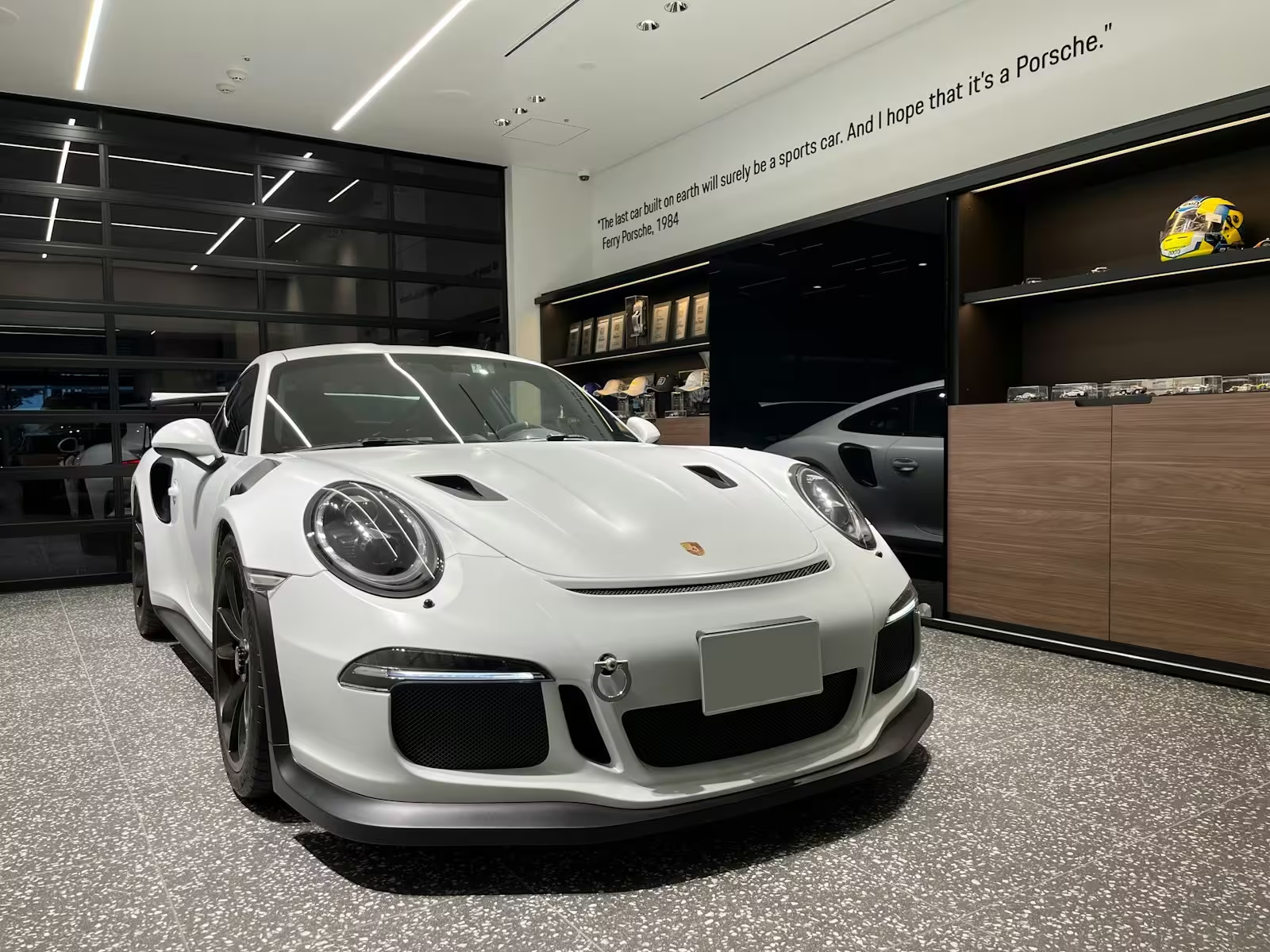
Concierge enclosed transport · 8 marques · Owner-only handoff
Quick Decision
Luxury car transport or standard car shipping?
Vehicle value $70,000+ or marque sensitivity = luxury service. Under that, standard transport is fine.
Head to Head
Luxury concierge transport vs standard transport
What you actually get for the premium
The Process
How luxury car transport works
4 steps from quote to delivery — built around your car and your timeline
Transparent Pricing
What luxury car transport actually costs
Standard enclosed runs 40–60% above open transport. Single-car enclosed adds another 30–50% on top.
Luxury car transport pricing has three tiers, and which one fits depends on the vehicle and how concierge you want the service. Most owners go with multi-car enclosed (2–6 vehicles per trailer) — full protection, lift-gate loading, soft straps, at standard enclosed rates. Single-car enclosed adds significant cost but means your vehicle is the only one on the trailer — used for show cars, auction wins, and rare marques. Climate-controlled enclosed is the top tier, used for fresh restorations, museum pieces, and high-end concours entries.
Luxury car transport — per-mile rate by distance & carrier type
Real luxury route examples (multi-car enclosed)
High-value vehicle lanes we run regularly — actual multi-car enclosed transport prices for a luxury sedan or sports car:
Prices shown are multi-car enclosed rates for luxury sedans/sports cars. Larger luxury SUVs (Cullinan, Bentayga, Urus, DBX) add ~$200. Single-car enclosed runs 30–50% above multi-car rates. Climate-controlled enclosed is a separate quote — coordinate at booking. Peak season (Oct–Nov, Mar–May) can add 10–20%.
What changes the price on a luxury shipment
- Carrier type. Multi-car enclosed is standard. Single-car enclosed runs 30–50% more. Climate-controlled enclosed is the top tier — used for fresh restorations, museum pieces, concours-bound vehicles.
- Vehicle dimensions. Standard luxury sedans and sports cars price at baseline. Luxury SUVs (Cullinan, Bentayga, Urus, DBX) add ~$200. Wide-body custom builds may need single-car enclosed.
- Distance and corridor. Major lanes (I-95, I-10, I-40, I-80) price lower because enclosed carrier supply is steadier. LA ↔ NYC, NYC ↔ Miami, LA ↔ Miami are our most efficient corridors.
- Pickup accessibility. Concierge addresses (private homes, gated estates, hotel valets) are standard. Truly inaccessible locations may require a meeting at a nearby wide spot.
- Delivery window flexibility. Hard deadlines (concours show date, auction handover) may add a premium because the carrier loses scheduling flexibility. Flexible windows are baseline pricing.
- Marque sensitivity. Some carriers won't accept rare marques without single-car enclosed (Bugatti, Pagani, Koenigsegg, vintage Ferraris). We disclose this upfront, not after booking.
- Season. Auction season (Monterey Car Week, Scottsdale, Amelia Island) drives temporary demand spikes on enclosed capacity. Book early for these windows.
Carrier Vetting
How we vet every carrier handling a luxury vehicle
6 checks plus marque-specific experience verification. No exceptions.
After 10+ years of moving luxury vehicles, we've learned the difference between a carrier who can ship a Camry and a carrier who should ship a Ferrari. The base equipment matters — enclosed trailer, lift gate, soft straps. But the experience matters more. On a $300K car, a driver who has never handled one before will make small mistakes that add up. We verify marque experience as a separate check on top of the standard six.
A carrier that fails any one of these doesn't get your vehicle. Doesn't matter if their rate is the lowest on the board. On a $200,000 car, vetting matters more than rate. Period.
Marques We Ship Most
8 marques we ship every week
Marque-specific handling considerations from our dispatch books
Don't see your marque? We also ship Bugatti, Koenigsegg, Pagani, Ford GT, Acura NSX, Lexus LFA, Mercedes-AMG GT/SLS/SLR, and BMW M-series. For these and other rare or one-off vehicles, request a single-car enclosed quote.
White-Glove Protocols
What concierge handling actually means
Specific protocols on every luxury shipment — not marketing fluff
Honest Take
When luxury car transport isn't worth it
A few cases where standard transport makes more sense — we'll tell you
For pre-1980 originals and restored vintage vehicles, see our classic car shipping guide instead — different protocols, similar care.
Customer Reviews
What luxury car owners say about Navi
Recent reviews from customers who shipped high-value vehicles
Ready to ship your luxury car?
From $499 · $250K–$1M cargo insurance · Concierge handling · All 50 states
FAQ
Frequently asked questions
Direct answers to the most common luxury car transport questions
What type of transport is best for luxury cars?
Enclosed transport is the default for luxury vehicles, with multi-car enclosed handling most shipments cost-effectively. For rare marques (Bugatti, Pagani, Koenigsegg, P1, F50), single-car enclosed is often the right call. Climate-controlled enclosed is reserved for fresh restorations, sensitive interiors, and concours-bound vehicles. Open transport is technically available but rarely advisable above $70K vehicle value.
Do you ship Porsche, Ferrari, Lamborghini, and other specific marques?
Yes. Porsche, Ferrari, Lamborghini, Rolls-Royce, Bentley, McLaren, Aston Martin, and Maserati are the eight marques we ship most frequently. We also handle Bugatti, Koenigsegg, Pagani, Ford GT, Acura NSX, Lexus LFA, and Mercedes-AMG GT/SLS/SLR through single-car enclosed carriers. Flag your specific make and model at booking so we match the right carrier.
Can the driver operate a manual transmission?
Yes. Professional auto transport drivers are trained on both automatic and manual transmissions. The driver only needs to operate the vehicle briefly to load and unload from the trailer. Many luxury and sports cars have manual transmissions or gated shifters — flag at booking so we confirm the driver is comfortable with your specific vehicle.
Do enclosed trailers have a hydraulic liftgate?
Most enclosed trailers we use for luxury shipments include a hydraulic lift gate, which loads low-clearance vehicles without scraping the front splitter or undercarriage. Some enclosed trailers use extended ramps instead. For ultra-low-clearance vehicles (Ferrari 488, McLaren 720S, Lamborghini Huracán with aero pack), specify lift-gate-required at booking so we assign the right equipment.
What's the difference between multi-car enclosed and single-car enclosed?
Multi-car enclosed trailers hold 2–6 vehicles and are the standard for luxury shipments — full protection at a cost-effective rate. Single-car enclosed means your vehicle is the only one on the trailer. Costs 30–50% more but provides maximum individual attention and is the right call for rare marques, fresh restorations, or auction-bound vehicles with hard deadlines.
When is climate-controlled enclosed worth it?
Climate-controlled enclosed maintains temperature and humidity inside the trailer. It's worth it for fresh restorations (paint not fully cured), vehicles with sensitive interior materials (matte paints, exposed carbon, fragile leathers), museum pieces, and high-end concours entries. For most luxury shipments, standard hard-sided enclosed is sufficient. Coordinate at booking — carrier availability is limited.
Can the same driver handle my car the whole way?
On single-car enclosed shipments, single-driver continuity is standard. On multi-car enclosed, drivers may change at relay points depending on distance and federal hours-of-service rules. If single-driver continuity is critical, request it at booking — we'll match a carrier whose schedule covers the full route.
How long does luxury car transport take?
Pickup runs 2–5 days from booking — slightly longer than standard transport because enclosed luxury carriers are less common. Transit times: short routes (under 500 mi) 3–5 days, mid-distance 5–7 days, cross-country 8–10 days. Add 1–2 days during peak auction seasons (Monterey Car Week, Scottsdale, Amelia Island) when enclosed capacity tightens.
How is my vehicle's condition documented before pickup?
The driver photo-documents your vehicle from all angles at pickup — paint, wheels, interior, undercarriage where accessible. Same documentation at delivery. Photos are sent to you and stored on the order, so any damage claim is settled with evidence. This is standard on every luxury shipment, not an upcharge.
What insurance coverage does my luxury car have during transport?
Enclosed carriers carry $250,000 to $1,000,000+ in cargo coverage per vehicle, verified on every load. For vehicles with declared value over $1M (Bugatti, Pagani, Koenigsegg, F50, P1, vintage Ferraris), we arrange additional coverage. Active policies confirmed before assignment — no exceptions.
Can you coordinate delivery around a concours or auction date?
Yes. Tell us at booking — Monterey Car Week, Scottsdale Auction, Amelia Island Concours, Pebble Beach, and other hard-deadline events are handled regularly. The carrier is scheduled around the arrival date. Coordinated delivery windows are part of the standard luxury service, not a premium add-on.
Do I need to be there for pickup and delivery?
You or an authorized representative (18 or older) needs to be present at both pickup and delivery for the inspection walkaround, Bill of Lading signature, and photo documentation review. On luxury shipments, owner-only handoff is standard — the driver verifies ID before releasing the vehicle. Designate a recipient at booking if it won't be you.